Olympia Unitarian Universalist Congregation
Sunday, November 23, 2025
“Forming and Unforming Together: Lessons learned along spiritual journeys”
with Rev. Sara Lewis
Rev. Sara has practiced as a religious educator and spiritual director, and reflects on lessons learned about how the spiritual journey is relational and shared.
Chalice Lighting
Weavers of One Story
by Leah Ongiri
Here we are
together
each facing our different human tasks
or maybe the same central one:
to embrace the lessons life delivers
to discern and respond as we grow
to refuse harm and cherish flourishing
May we know ourselves
as vessels of infinite possibility
Holders of each other’s heartaches and tales of joy alike
weavers of one story
in which we each have our part
Opening Words
The Heart of Our Faith
by Rev Monica Jacobson Tennessen
What is it
That calls you here
That calls you onward
That calls you inward
That leads you homeward?
What is it
That gives you the power
To make that change
To ask that question
To take that journey?
What is it
That says you have done well
That asks you to learn more
That brings you to stillness
That holds you up in hard times?
It is relationship
The beating heart of our faith.
It begins when we share
This hour
Our truths
This air
Our hearts.
Reading 1
Our Unforming: De-Westernizing Spiritual Formation
by Cindy S. Lee
Western spirituality developed based on a desire for certainty. A spirituality of certainty utilizes religion to give us a sense of control by setting rules and delineating beliefs that will not change. A spirituality of certainty is located in the mind. It is verbal and literate because it depends on human language to define God. …
Those with privilege and power can especially build their lives around the delusion of certainty. Those with more influence and wealth can attempt to build up walls of protection against uncertainty using their power to control circumstances and the people around them. But any certainty we attain is always temporary. Those who live in poverty and oppressive conditions recognize they have no choice but to live in a constant state of uncertainty. …
Triumphalism is the false assumption that we, the privileged, deserve to keep moving upward, to achieve, and to succeed. The US culture of triumphalism allows us to pretend that because we worked hard, good things come to us, and we are therefore immune to bad things. Triumphalism has also invaded how we live into our faith. A just work harder society creates a just work harder religion. Because of our privileged positions in life, we are surprised by suffering each time it comes near.
Part 1: Unforming Together
I am a person who likes to study, to read, to go to school, and to learn. I’ve pursued years of education and I’ve grown in the process. In the different frameworks that I’ve been through I’ve been built, educated, developed, formed, or whatever word the programs might use. All of that has been very important to who I am today, but the formation doesn’t stand out as the pivotal moments. It was the times of unforming that really stopped me in my tracks, shifted my unthinking assumptions and biases, and transformed me. Moments of heartbreak, betrayal, shock, and tragedy, those hitting bottom moments when I felt like I was falling apart. But unforming moments were also moments of transcendence, beauty, unexpected grace and love, and resiliency. What my unforming moments have in common are their unexpectedness and the way they shook up all my plans and assumptions. They weren’t achievements, and I didn’t earn them.
Most of us have grown up in the western educational model and western spiritual tradition, and the assumptions and goals of those traditions, just like other aspects of our culture, can be largely invisible to us. As the saying goes, it’s the water we swim in, so we may not realize that these mindsets and attitudes towards learning and spirituality are not the only possibility. I appreciate the work of Cindy S Lee, the author of our first reading, as well as each of the non-Western spiritual teachers I have been fortunate to take a workshop or class from, who have challenged my assumptions about time, relationship, language, and more. When I first began my work as a religious educator, I had a set of clear cut goals and a content map I was committed to. Over my 17 years in this work and all I’ve learned, most of my goals and content ideas have become much less fixed. I’ve unformed and let go of much of it.
I’m reminded of something my organic chemistry professor said when I was an undergrad. He told me that as I went further and learned more and more, I would be constantly discovering that I had been in some ways lied to by the simpler explanations I was taught at a lower level of science education. The more you study, the less you know and the weirder it gets, he said. I changed course and didn’t pursue chemistry further, but this wisdom has been transferable to learning and growing in general. The more I learn, the less I know for sure, in a cognitive head-centered certainty type of knowing.
And yet in general our model of education and faith doesn’t lean into the unknowing, but is instead modeled after climbing a ladder toward more and more and more – more knowledge, more competence, more certainty and confidence. And too often the climb is to a goal that lets us graduate and stop there. That’s it, we know everything, we are formed, we are done.
Compared to some other religious traditions, we UU’s may think we aren’t stuck in this model. And it’s true that without a set dogma or doctrine we are a bit more open to unknowing. Our religious education programs for children became experientially focused in the early 20th century, far ahead of the norms for Sunday school learning. So why am I preaching this message to UU’s?
Well, partly this message is for UU’s because we actually have historical roots in creating a triumphalist just-work-harder kind of faith. Our American Unitarian ancestors were the Harvard educated elites of Boston who championed the idea that humans can perfect themselves through character development and education. Our faith ancestors took this ethos in directions that we see now as positive, such as championing free public schools. And they sometimes took that ethos of education and human development in directions we now see as wrong, such as when they formed a mission to the Utes as part of the “civilizing” project of the 19th century or supported the eugenics movement. Our belief in the perfectability of humans and in onward and upward forever is right in alignment with the triumphalism and seeking certainty that our reading critiqued.
If hearing about these times UU’s have made mistakes is a bit uncomfortable or unsettling or changes the way you feel about your faith, you might be having a bit of unforming. In learning theory this phenomenon is called cognitive dissonance, a time when new learning or experience contradicts the way you have thought before and threatens the paradigms you have held. Cognitive dissonance is an important and necessary step in learning, otherwise we’d all still hold the same paradigms about the world we did when we were children. The townspeople in our story experienced cognitive dissonance when they realized that getting the same answer all the time wasn’t useful to them. They had to change their paradigm for what makes a good answer.
But the term “cognitive dissonance” doesn’t include the fullness of unforming. Unforming is heart dissonance, soul dissonance, whole-being dissonance. Sometimes unforming is more than uncomfortable. Sometimes unforming comes from trauma, and sometimes unforming brings us back to unhealed trauma we’ve compartmentalized within us. Unforming is rocky terrain.
Which brings me to the “together” part of the title for this reflection. It’s good to have company and support with us when we encounter our unformings. When a person is in an unforming process, others can hold space and support them, can reassure them that they are not alone, that this too shall pass, and that we all unform sometimes. This congregation can be a community that holds us all in times of unforming and even in times of falling apart.
Many years ago, when I was leading a Day of the Dead ritual for children here, an 8 year old boy brought the whole proceeding to a stop when he told a long and rambling story about his grandfather, and then began to weep. Some of the other kids didn’t know what to do, but some did. Some of them cried with the boy, and some of them came and hugged him gently. He was then able to come forward and light a candle for his grandpa. Afterward he told me something that has stuck with me ever since. He told me that he loved coming to church because he was sad and at home and at school it wasn’t OK to be sad. But church is a place where it’s OK to be sad. Moments like that are when the importance of a faith community become clear.
But we don’t always live up to that ideal of support and safety for times of unforming. There are so many ways we can mess that up. We can be so focused on forming and on try-harder learn-more models of faith that we don’t leave room for the unforming. Onward and upward forever, no pauses for the messy bits. We can be uncomfortable with unforming and engage in subtle acts of exclusion that makes it clear that those who are unforming should go do that somewhere else. We can minimize and tell people that they are making too much of a big deal of it. We can lack trauma awareness and re-injure those who are already hurting.
If any of these examples of falling short as a community have happened to any of you when you needed us to hold space and be there for you, I am sorry that happened. When we mess up, even when we didn’t mean to mess up, it’s important for there to be repair. So I would like to invite you into a practice of repair right now. It’s optional, of course. This practice will move straight into the musical interlude, so if you need to just pull back right now and the music will be your cue to return your attention here.
Let’s all take a couple deep breaths. Notice how we are held by our chairs, by gravity, by the earth. We are held, always. Notice how you are safe right now and if your body would like something more to feel even safer, such as hugging yourself, make that adjustment.
For those who are willing, please close your eyes and reflect back to a time you were engaged in unforming. Learning about white supremacy culture for the first time, or losing faith in something or someone, or encountering loss, or any other time of unforming. As much as is safe for you now, let yourself feel those feelings again. Then look around – who was with you then? Who held space for you? And how were you not held by others? What do you wish you had received?
Be tender with yourself, and hold that vulnerable and possibly hurting part of you in love. And now we move to part two as we shift our focus from within ourselves to everyone else in this space and all those online as well. Think of all these people and all the tender and vulnerable parts of them that are there just like your tender and vulnerable parts. In your heart and mind, hold space for these other people and send them these messages:
You are not alone
There is space here for all your thoughts and feelings
I am sorry for the ways we have fallen short, the ways you have been left to deal with it on your own
Together, let us journey toward being a more loving community
We are together
Reading 2
“Freeing Jesus: Rediscovering Jesus as Friend, Teacher, Savior, Lord, Way, and Presence”
by Diana Butler Bass
I have come to understand the problem was more with my definition of “teacher” than with Jesus. Like many others I mostly thought of teachers as guardians of a set of middle class values and civic virtue, as those who instilled conventional ideas about citizenship and history. This is not a particularly bad designation, but it inhibits creativity and questioning, often reducing education to a set of fairly benign principles about conformity and acceptability. …
I learned that teachers were far more than dispensers of information or guardians of civic orthodoxy. The best ones did not teach to anybody’s test. Instead, they taught from the heart by raising questions and presenting material in surprising ways.
Indeed the best teachers I have ever known – as well as the teacher I aspire to be – nurtured a way of being in the world ….
Part 2: Forming Together
I first trained as a teacher, and then as a religious educator. I love teaching, but I am troubled by the stereotype of teacher we have in the western tradition. A teacher as one who has the answers and an established body of knowledge to transmit to students, as well as a guardian of the status quo of social norms that trains students to conform to what is expected of them. That is not the kind of teaching I have any interest in. Fortunately we have role models of great spiritual teachers who were nothing like that. Buddha, Moses, Jesus, and many others show an example of a spiritual teacher who might have some specific knowledge, laws, practice, or wisdom to transmit but most of all moved people toward a different way of being in the world.
These different approaches to education or formation are given a nice metaphor in the book The Gardener and the Carpenter: What the New Science of Child Development Tells Us About the Relationship Between Parents and Children, by evolutionary developmental scientist Alison Gopnik. In this work Gopnik uses the metaphor of a carpenter for the old model of teaching or parenting, of forming up a child. A carpenter has a blueprint, a plan, and a clear goal, and crafts the raw materials into the desired shape, including by cutting away what doesn’t fit. On the other hand, a gardener supports the growth of what will be. A gardener may still train a plant into going a desired direction, or trim one part so growth focuses elsewhere, but the gardener cannot fully control the plant and knows that.
She writes:
“So our job as parents is not to make a particular kind of child. Instead, our job is to provide a protected space of love, safety, and stability in which children of many unpredictable kinds can flourish. Our job is not to shape our children’s minds; it’s to let those minds explore all the possibilities that the world allows. Our job is not to tell children how to play; it’s to give them the toys and pick the toys up again after the kids are done. We can’t make children learn, but we can let them learn.”
Extend this idea to people of all ages. We cannot make anyone learn or grow, but we can provide a protected space of love and safety that allows growth to happen. Like the gardener, we can work to create an environment that allows for flourishing.
In the last five years, I’ve added a new training and role to my ministry, as a certified Spiritual Director. Spiritual Direction is not well known, so in brief I’ll explain that spiritual directors are trained to hold space for others’ spiritual and faith questions, experiences, and challenges. It is a bit like counseling, a bit like pastoral care, a bit like coaching, but it is none of those things exactly. I have a private practice as a spiritual director, and I typically meet with a client for an hour a month for a regular and planned session. I’ve had a few clients for more than three years now, while others have met with me for a while and then stopped. I’ve gained a new perspective on spiritual formation through serving in this role. It’s a real privilege to be witness to the depths and the long term arc of another’s faith journey.
As a quick side note to anyone who is curious about working with a spiritual director, it would be unethical for me to work with anyone at OUUC as a spiritual director, but I can refer you to some resources for finding a director.
One of the lovely things I have seen as a spiritual director is the way being truly listened to invites a deep sharing that can help a person realize truths for themselves. Over and over again someone will say “and now that I’m saying it out loud I realize ….”. This isn’t the only discipline where this can happen, of course, but for some people it’s the most effective way for them to get to these deeper understandings.
Another role I play as a spiritual director is to be a non-judgmental mirror. Just as practicing a dance step in front of a mirror can show you whether you’re doing what you hope you are doing, having another person repeat back what they are hearing or noticing from your sharing can bring more self-understanding. I sometimes just point out a word choice – you keep saying “should” for instance. Or I might share that I hear a particular emotional undertone to what is being said. I’m not always right, but that’s OK too and might lead to a different kind of learning.
And with the clients that I have been seeing for years I am a witness for growth. I can point out how much change has occurred over time, or that there might be a recurring theme that comes up seasonally for them. Having a witness know and remember the path we have explored can help us get back on track when we’ve wandered or give us mileposts to celebrate.
I share these because we can do these things for each other here in our community of faith as well. We can all be the witness and the witnessed as we are on our own individual journeys of spiritual formation but we are also here together. Just as we can hold space for the unforming times, we can also hold space and witness the formation as well. We can listen to understand rather than to debate. We can mirror and witness for each other. We can ask gentle questions from a place of curiosity. When needed, we can push back on harmful behaviors or patterns of thinking and help each other see our own biases.
Overall, OUUC is pretty good at this. A few years ago we took part in a UUA wide project to collect answers to the question “what is it we teach and learn here?” and word clouds were created for each participating congregation. When the word clouds were made public, I noticed that ours was a bit different than the others. Here is our word cloud:
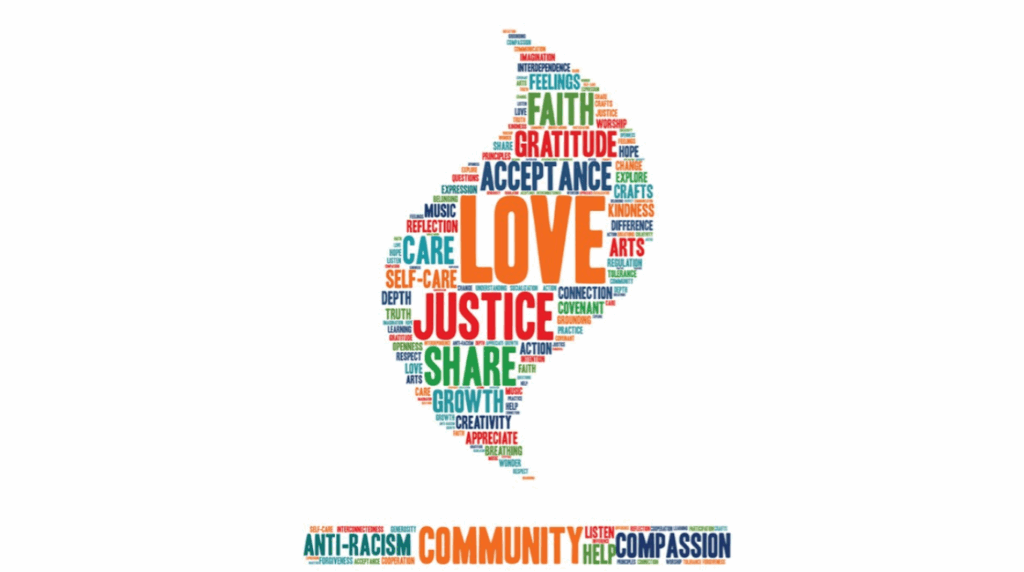
The way these word clouds work is that words that were more common in the responses are shown bigger. The biggest word was the most commonly used. All the word clouds from every congregation placed Love at the center as the biggest word. But OUUC’s cloud has some words that weren’t common or present at all in other word clouds:
Care
Self-care
Regulation
Breathing
Grounding
Healing
Forgiveness
Help
I felt pretty proud of us when I saw our word cloud, and I think it reflects the work of many here, most obviously Rev Mary, to bring healing and trauma informed practices into our congregational practice at all levels. I think the reason our word cloud was chosen for the front cover of the UUA book Love at the Center is because of these words that show how we put healing and growth both into our teaching and learning.
Now I’m sure these are present in other congregations too, and I also know that we aren’t perfect in our teaching or our learning. What we shared in our word cloud may be aspirational as much as actually manifest in how we are together. But our aspiration is a beautiful one.
So let’s fully live into our vision of what we teach and learn here. Let us hold space lovingly for the necessary unforming work that everyone will encounter at some point. Let us practice repair and forgiveness with grace and humility. Let us balance our individual journeys with the joy of support and witness that comes from togetherness. Let us be nurturing gardeners for the full unfolding of each unexpected miraculous unique person. There is no blueprint, no goal, and no one will ever be finished. None of us gets to graduate from our formation process, not in this world or this lifetime for sure.
On this long and windy and unknown journey, let us be companions for one another.
Closing Words
Let Us Be That Circle
by Craig Rowland
As we extinguish this flame,
may we carry its warmth into the world
not as a memory,
but as a promise.
A promise that you deserve
a place where your voice matters,
where your laughter is treasured,
and your silence is honored.
You deserve a circle
that sees your scars and your strength,
your doubts and your radiance,
and holds them all with care.
Let us be that circle for one another—
a community of fierce welcome,
wild grace,
and radical hope.
Go knowing:
You belong here.
You always have.
Reflection questions:
● What times of unforming have transformed you?
● Who are the people who have journeyed with you through unforming and forming?
● How can we better be a community of companionship for these spiritual journeys?